
15 High-Paying Aviation Careers You Can Pursue After Flight Training
August 16, 2026
Choosing aviation as a career is a major decision. The investment in training can be substantial, and becoming a professional pilot requires commitment, discipline, medical fitness, examinations, flight training and continuous learning.
But there is one important point many aspiring pilots overlook:
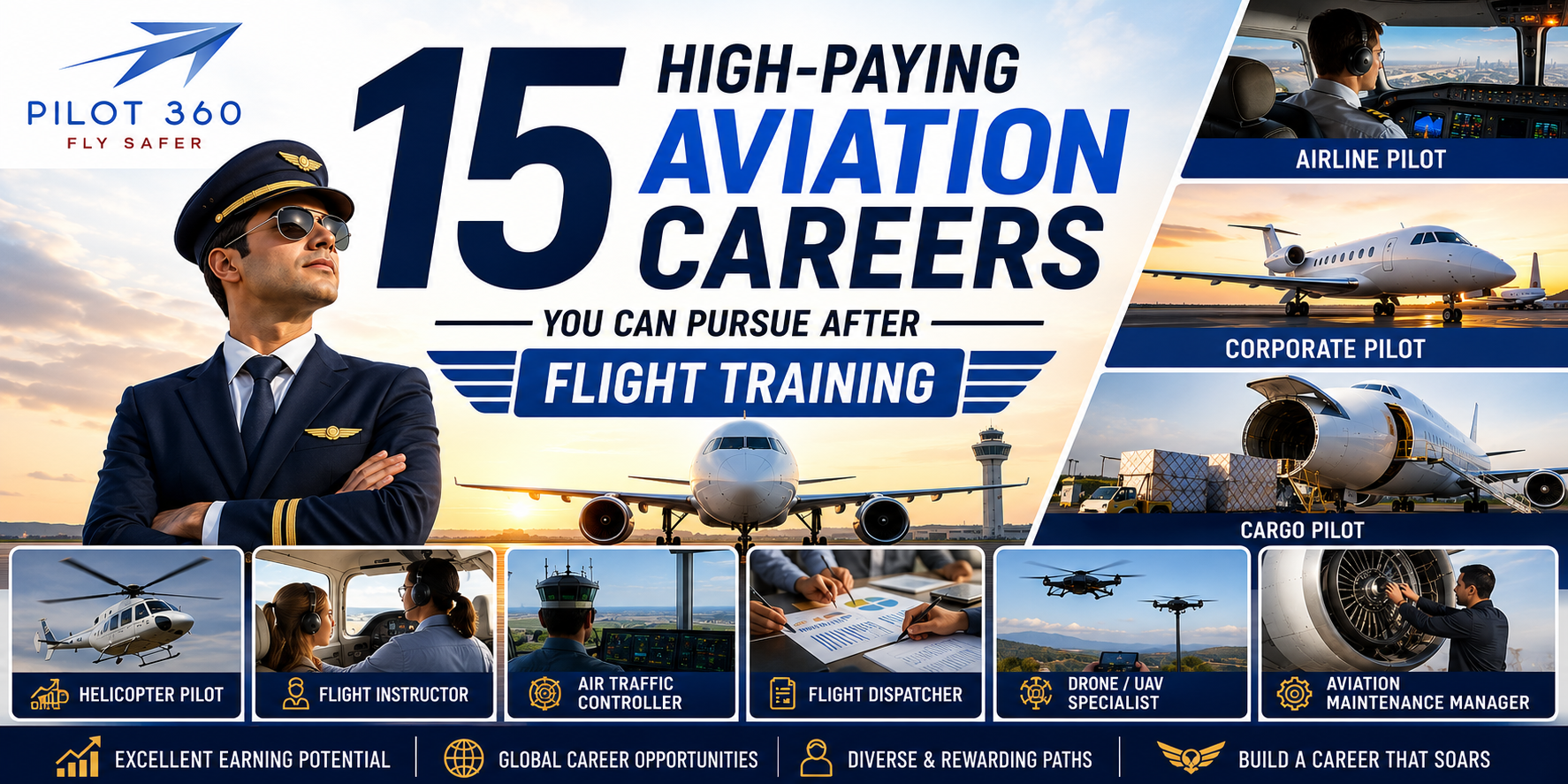
Aviation is much bigger than the airline cockpit.
While becoming an airline pilot or captain is the goal for many students, flight training and aviation knowledge can open doors to several other careers across commercial aviation, corporate aviation, cargo operations, flight instruction, safety, airport operations, drones and aviation management.
In this guide, we explore 15 aviation careers with strong earning potential and long-term growth opportunities, along with the qualifications and skills that can help you progress.
1. Airline Captain
For many professional pilots, becoming an airline captain represents the long-term career goal.
Captains have overall responsibility for the safe operation of the aircraft and work closely with the first officer, cabin crew, air traffic control and airline operations teams.
The role involves much more than physically flying the aircraft. Captains are responsible for:
Flight planning and operational decisions
Crew coordination
Weather assessment
Aircraft systems monitoring
Safety decisions
Communication with operations teams
Managing abnormal and emergency situations
Reaching the captain position generally requires substantial flying experience, additional qualifications, aircraft type ratings and progression through an airline's seniority and training system.
For ambitious pilots, this is one of the most senior and potentially highest-earning positions in commercial aviation.
2. Commercial Airline Pilot / First Officer
Most airline pilots begin their airline careers as first officers.
First officers work alongside the captain and are involved in:
Flight preparation
Navigation
Radio communication
Aircraft systems
Checklists
Flight monitoring
Crew coordination
Operational decision-making
With experience, training and the required qualifications, a first officer can progress toward senior first officer and eventually captain roles.
For students whose ultimate goal is to fly passenger aircraft, this is usually the most direct professional pathway after completing the required pilot training and licensing.
3. Corporate Jet Pilot
Corporate aviation offers another career path for professional pilots.
Corporate pilots operate business aircraft for companies, executives, private clients and charter operators.
The role can involve:
Business jet operations
Short-notice schedules
Smaller airports
Domestic and international travel
VIP passenger service
Detailed flight planning
Corporate pilots need excellent professionalism, communication skills, discretion and flexibility.
Experienced pilots operating larger or more sophisticated business aircraft can have strong earning potential.
4. Cargo Airline Pilot
Passenger airlines are not the only operators that need professional pilots.
Cargo aviation transports:
E-commerce shipments
Industrial equipment
Medical supplies
Express parcels
Commercial freight
Other time-sensitive goods
Cargo operations can involve night flying and different operational schedules from passenger airlines.
As India's logistics and e-commerce sectors continue to develop, cargo aviation represents an important part of the wider aviation ecosystem.
For pilots who enjoy flying but prefer cargo operations over passenger services, this can be an attractive career path.
5. Helicopter Pilot
Helicopter aviation provides opportunities in several specialized industries.
Helicopter pilots may work in:
Offshore operations
Tourism
Emergency services
Search and rescue
Infrastructure projects
Aerial surveying
Corporate aviation
Utility operations
VIP transportation
Helicopter flying requires specialized training and a different skill set from fixed-wing aviation.
Some of the more specialized helicopter operations can offer strong compensation for experienced pilots with the appropriate qualifications.
6. Flight Instructor
Becoming a flight instructor can be an important early-career opportunity for commercial pilots.
Flight instructors train student pilots in areas such as:
Aircraft handling
Take-offs and landings
Navigation
Flight procedures
Emergency procedures
Pre-flight preparation
Aviation theory
For many pilots, instructing is also a practical way to build flying experience and strengthen their technical knowledge.
Over time, experienced instructors can move into senior instructional, examiner, simulator, training management or airline positions, depending on their qualifications and career progression.
7. Simulator Instructor
Modern pilot training relies heavily on advanced flight simulators.
Simulator instructors help pilots practice:
Normal flight operations
Instrument procedures
Aircraft systems
Engine failures
Emergency procedures
Adverse weather scenarios
Crew resource management
One of the major advantages of simulator training is that complex and abnormal situations can be practiced in a controlled environment.
Experienced pilots with strong aircraft-specific knowledge can pursue simulator and training roles with airlines, training organizations and simulator centers.
Pilot360 also offers airline preparation and type-rating pathways, supporting pilots who want to develop skills relevant to airline operations.
8. Aircraft Dispatcher
Aircraft dispatchers work closely with pilots and airline operations teams before and during flights.
Their responsibilities can include evaluating:
Weather
Routes
Fuel requirements
Airport conditions
Aircraft limitations
NOTAMs
Operational risks
Dispatchers help airlines plan flights safely and efficiently.
This is a ground-based aviation career, but it requires strong operational understanding, analytical thinking and knowledge of aviation procedures.
9. Aviation Safety Professional
Safety is at the center of every aviation operation.
Aviation safety professionals can work with:
Airlines
Airports
Flight schools
Charter operators
Maintenance organizations
Aviation companies
Their work may involve:
Safety reporting
Hazard identification
Risk assessment
Incident analysis
Safety management systems
Compliance
Safety improvement programs
Aviation professionals with operational experience can bring valuable practical knowledge to safety-related positions.
10. Flight Operations Manager
Flight operations managers coordinate the operational side of aviation businesses.
Depending on the organization, their responsibilities can include:
Crew scheduling
Flight coordination
Operational planning
Regulatory compliance
Disruption management
Documentation
Coordination between departments
This career can be particularly suitable for aviation professionals who want to move into leadership and management while remaining connected to flight operations.
11. Drone Pilot and UAV Specialist
The growth of unmanned aircraft systems has created another area of opportunity for aviation professionals.
Drone and UAV specialists can work in industries such as:
Agriculture
Construction
Mapping
Land surveying
Infrastructure inspection
Filmmaking
Disaster management
Logistics
Environmental monitoring
The drone industry is developing rapidly, and professionals with aviation knowledge combined with technical or specialized UAV skills can explore opportunities beyond traditional manned aviation.
However, drone operations have their own regulatory and certification requirements, so students should understand the applicable rules before entering this field.
12. Aviation Consultant
Experienced aviation professionals can eventually move into consulting.
Aviation consultants may advise organizations on:
Fleet planning
Flight operations
Training
Safety
Airport development
Aviation strategy
Regulatory compliance
Operational efficiency
This is generally not an entry-level career.
Consulting becomes more valuable when a professional combines aviation experience with additional skills such as:
Business
Finance
Data analysis
Strategy
Operations
Project management
13. Aircraft Sales and Aviation Business Development
Aviation also creates opportunities outside direct flight operations.
Aircraft sales professionals work with:
Aircraft manufacturers
Operators
Brokers
Leasing companies
Corporate clients
Private aircraft buyers
A strong understanding of aircraft performance, range, operating requirements and mission profiles can be useful in this career.
Professionals with both aviation knowledge and strong sales or business-development skills can build careers in this specialized segment.
14. Aviation Manager
Aviation managers can work across different areas of an airline, airport, flight school or aviation organization.
Depending on the organization, management positions can involve:
Ground operations
Flight operations
Safety
Customer service
Training
Commercial operations
Staff management
Aviation management is particularly relevant for professionals who want to progress from technical or operational roles into leadership positions.
15. Aviation Maintenance Management
Aircraft maintenance is another critical part of the aviation industry.
Maintenance management professionals coordinate activities related to:
Aircraft inspections
Maintenance schedules
Engineering teams
Documentation
Parts
Aircraft availability
Regulatory compliance
This career typically requires a specific technical maintenance background rather than a pilot licence alone.
However, aviation professionals who understand both flight operations and maintenance can develop valuable cross-functional knowledge when moving into senior aviation management.
Which Aviation Career Pays the Most?
There is no universal answer.
An experienced airline captain may have significantly higher earning potential than an entry-level flight instructor. Similarly, a specialized corporate, helicopter or cargo pilot may earn differently depending on the aircraft, employer and experience.
Your earning potential can be influenced by:
License level
Aircraft type
Type rating
Total flight hours
Employer
Seniority
Location
International experience
Specialized qualifications
Management responsibility
Therefore, students should not choose a career based exclusively on the highest advertised salary.
The Better Question to Ask
Instead of asking:
“Which aviation job pays the most?”
Ask:
“Which aviation career fits my skills, qualifications, financial goals and long-term interests?”
That question leads to a much better career decision.
What Skills Do Aviation Employers Look For?
Aviation employers look beyond licenses and certificates.
Communication
Pilots and aviation professionals must communicate clearly with colleagues, air traffic control, operations teams and other stakeholders.
Situational Awareness
Aviation professionals need to understand changing conditions and identify potential risks.
Decision-Making
Good aviation professionals make decisions based on facts, procedures, available information and safety considerations.
Teamwork
Modern aviation depends heavily on coordinated teamwork.
Discipline
Aviation involves strict procedures, checklists, schedules and regulatory requirements.
Technical Knowledge
Aircraft systems and aviation technology continue to evolve, making continuous learning essential.
English Proficiency
English is an important professional language across international aviation, including training, technical documentation and radio communication.
Adaptability
Aviation professionals regularly deal with changing weather, schedules, operational requirements and technological developments.
Does Flight Training Only Lead to an Airline Career?
No.
This is one of the biggest misconceptions among students.
Flight training can be the foundation for several aviation pathways, although the qualifications required for each career are different.
Depending on your license, experience and additional qualifications, you may eventually explore:
Airline operations
Corporate aviation
Cargo aviation
Flight instruction
Helicopter operations
Simulator training
Flight operations
Aviation safety
Aviation management
UAV operations
Aviation consulting
Your first aviation job does not necessarily have to define your entire career.
How Can You Build a High-Earning Aviation Career?
High earnings generally come with experience and specialization—not immediately after obtaining a license.
A practical long-term strategy can involve:
Build your foundation → Obtain the required license → Gain experience → Add ratings and qualifications → Build industry expertise → Target specialized roles → Progress into senior positions
For pilots, additional qualifications such as instrument, multi-engine and aircraft type-specific training may become relevant depending on the intended career path.
Pilot360 provides access to training pathways and aviation support across multiple destinations, including the USA, India, Canada, South Africa, New Zealand, Australia and Europe.
Why Your Flight Training Choice Matters
Your career does not start when you get your first airline job.
It starts when you choose your training pathway.
Students should evaluate factors such as:
Regulatory approvals
Training quality
Aircraft availability
Instructor experience
Flying opportunities
Weather conditions
Total training cost
Accommodation
Student support
License conversion requirements
Career guidance
Choosing a flight school solely because it advertises the lowest price can be risky.
A cheaper initial fee does not necessarily mean a lower final cost if aircraft availability, scheduling, additional flying hours or other expenses become problems.
Why Consider Pilot360?
Pilot360 focuses on helping aspiring pilots navigate the aviation career journey from initial planning through training and career preparation.
Its services include:
Career counselling
DGCA medical assistance
DGCA Computer Number assistance
Flight-school selection
International flight-training options
License conversion support
Aptitude and psychometric preparation
Interview preparation
Aircraft type-rating pathways
Pilot360 currently works with training options across multiple international destinations and promotes end-to-end assistance for aspiring pilots.
The company's training ecosystem includes pathways involving PPL, CPL, Instrument Rating and Multi-Engine Rating, along with airline-focused preparation and type-rating options.
Start Planning Your Aviation Career
The aviation industry offers far more career opportunities than many students initially realize.
Becoming an airline captain may be the ultimate goal for one student, while another may find a better fit in corporate aviation, cargo, helicopter operations, flight instruction, simulator training, safety, operations or aviation management.
The important thing is to understand the career options before making a major investment in training.
Aviation careers are built step by step:
Choose the right pathway → Complete the required training → Build experience → Add relevant qualifications → Develop professional skills → Progress into higher-responsibility roles
If you are considering a career in aviation, Pilot360 can help you understand your training options, licensing pathway and potential career direction.
Your aviation career starts long before your first airline flight. It starts with making the right training decision.
Ready to Start Your Pilot Journey?
Talk to Pilot360 about your eligibility, training options, preferred destination and long-term aviation career goals.